
VibroMap — Full Field Laser Vibrometer
Overview
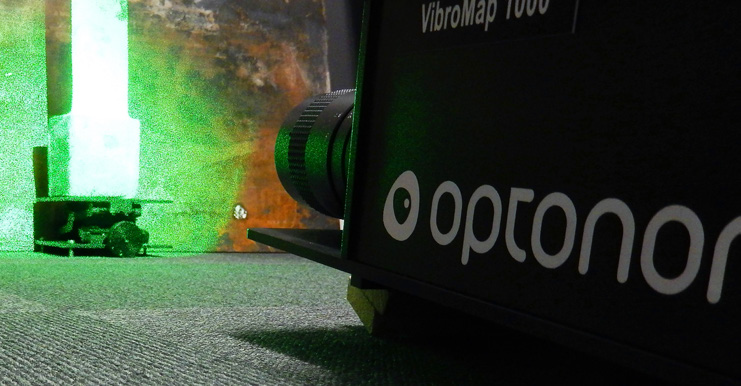
VibroMap is a full‑field laser vibrometer designed for real‑time, non‑contact vibration measurement of mechanical structures, composites, and micro‑components. Using interferometric imaging, VibroMap captures complete mode shapes across the entire surface in a single acquisition — eliminating the need for point‑by‑point scanning.
Engineers and researchers use VibroMap to analyze resonance behavior, detect structural defects, validate simulations, and characterize dynamic performance with high spatial and temporal resolution.
Key Features
- Full‑field vibration measurement — all points measured simultaneously
- Real‑time mode shape visualization
- High‑frequency capability (DC to high‑MHz range)
- Non‑contact, non‑destructive
- High spatial resolution (camera‑limited)
- Robust to environmental motion
- Fast measurement cycles for R&D and production environments
Measurement Principle
- A coherent laser illuminates the surface.
- Reflected light interferes with a reference beam.
- A high‑resolution camera records the interference pattern.
- Phase extraction algorithms compute displacement for each pixel.
- Mode shapes and frequency responses are reconstructed in real time.
Because every pixel acts as an independent detector, VibroMap captures complete vibration fields instantly, even at high frequencies.
Applications
Aerospace & Composites
- Delamination detection
- Impact damage assessment
- Modal analysis of lightweight structures
Mechanical Components
- Resonance identification
- Structural optimization
- Noise and vibration troubleshooting
MEMS & Micro‑Devices
- High‑frequency mode shapes
- Packaging effects
- Device characterization
Research & Development
- Experimental modal analysis
- Validation of simulation models
- Material behavior studies
Measurement Workflow
- Mount the object
- Illuminate with the integrated laser
- Adjust focus and reference beam
- Apply excitation (optional)
- Acquire interferometric images
- Extract phase and compute vibration data
- Visualize mode shapes
- Export results for analysis or reporting
The workflow is deterministic, repeatable, and optimized for rapid iteration.
Example Outputs
Frequency Response
Identification of natural frequencies and damping characteristics.
Defect Localization
Stiffness anomalies visible as distortions in mode shapes.
Mode Shapes
Full‑field visualization of resonant behavior across the entire surface.
Technical Specifications
Parameter | Specification |
Measurement type | Full‑field interferometric vibrometry |
Frequency range | DC to high‑MHz (model‑dependent) |
Spatial resolution | Camera pixel‑limited |
Displacement sensitivity | Sub‑nanometer (application‑dependent) |
Illumination | Coherent laser source |
Surface types | Diffuse or specular (with optional preparation) |
Acquisition mode | Real‑time, full‑field |
Output data | Displacement, velocity, mode shapes, frequency response |
Why Choose VibroMap
- Instant mode shapes without scanning
- High‑frequency capability suitable for advanced materials and microstructures
- High spatial resolution for detailed structural analysis
- Proven performance in aerospace, MEMS, and composite research
- 20+ years of interferometry expertise behind the system
VibroMap is built for engineers and researchers who need accurate, reproducible, high‑resolution vibration data — without compromise.
📞 Contact Optonor
For demonstrations, technical discussions, or application support, our team is ready to help.
Request a demo →