
3D Microstructure Vibration Measurement
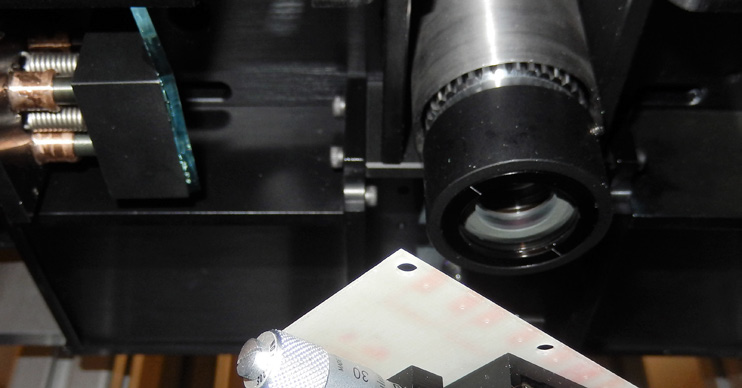
Overview
Micro‑electromechanical systems (MEMS) and micro‑structured devices operate at high frequencies, small amplitudes, and extreme spatial scales. Their dynamic behavior is critical to performance, reliability, and yield — yet notoriously difficult to measure using traditional techniques.
Full‑field interferometric vibrometry provides a non‑contact, high‑resolution, real‑time method for visualizing and quantifying vibration in MEMS devices and microstructures. It captures complete mode shapes across the entire device surface, enabling engineers to validate designs, detect defects, and characterize performance with unmatched clarity.
This guide explains the principles, challenges, and applications of microstructure vibration measurement, and how full‑field vibrometry overcomes the limitations of conventional methods.
Why MEMS Vibration Measurement Is Challenging
MEMS devices operate in a domain where traditional measurement tools struggle:
Scale
- Structures are often tens to hundreds of microns
- Amplitudes can be nanometers or less
Frequency
- Resonances commonly fall in the kHz to high‑MHz range
- Some devices operate in the tens or hundreds of MHz
Sensitivity
- Small mass and stiffness variations significantly affect performance
- Packaging stress can shift resonance frequencies
Access
- Devices are often encapsulated or partially enclosed
- Contact methods are impossible
Environmental sensitivity
- Air damping
- Temperature drift
- Mechanical coupling
Full‑field laser vibrometry is uniquely suited to this domain.
How Full Field Vibrometry Measures MEMS Dynamics
Full‑field vibrometry uses interferometric imaging to measure out‑of‑plane vibration across the entire device surface.
Measurement process:
- A coherent laser illuminates the MEMS device.
- Reflected light interferes with a reference beam.
- A high‑resolution camera captures the interference pattern.
- Phase extraction algorithms compute displacement for each pixel.
- Mode shapes and frequency responses are reconstructed in real time.
Why this works for MEMS:
- Pixel‑level resolution captures micro‑scale geometry
- High‑frequency capability resolves MHz‑range resonances
- Non‑contact avoids mass loading
- Full‑field acquisition reveals complex mode shapes
Real‑time measurement supports rapid iteration
Advantages Over Other MEMS Measurement Methods
Method | Limitations | Full‑Field Vibrometry Advantage |
Laser Doppler vibrometry (single‑point) | Slow scanning, limited spatial detail | Full‑field, instant mode shapes |
Stroboscopic microscopy | Requires periodic excitation, limited frequency | Works across wide frequency ranges |
AFM / probe methods | Contact, mass loading, slow | Non‑contact, fast |
Electrical characterization | Indirect, no spatial information | Direct spatial mode shapes |
SEM imaging | Static only, vacuum required | Real‑time dynamic measurement |
Full‑field laser vibrometry provides direct, high‑resolution, spatially rich dynamic information that no other method can match.
What Full Field Laser Vibrometry Measures in MEMS
- Resonance Frequencies
Identify natural frequencies with high precision.
- Mode Shapes
Visualize spatial vibration patterns across the device.
- Amplitude Distribution
Quantify displacement at each pixel.
- Packaging Effects
Measure how encapsulation shifts dynamic behavior.
- Manufacturing Variations
Detect stiffness or mass inconsistencies.
- Failure Modes
Identify cracks, delamination, or structural fatigue.
Applications
MEMS Resonators
- Frequency characterization
- Mode shape validation
- Quality factor analysis
Micro‑Mirrors & Optical MEMS
- Mirror tilt dynamics
- Torsional mode shapes
- Actuator performance
Sensors & Actuators
- Accelerometers
- Gyroscopes
- Pressure sensors
RF MEMS
- High‑frequency switching elements
- Micro‑inductors and capacitors
Micro‑Mechanical Structures
- Cantilevers
- Bridges
- Plates
- Phononic structures
Example Outputs
High‑Frequency Mode Shapes
Visualization of MHz‑range resonances.
Amplitude Maps
Pixel‑level displacement fields.
Frequency Response Functions
Identify resonances, anti‑resonances, and damping.
Comparative Analysis
Before/after packaging or environmental changes.
Measurement Workflow
- Mount the MEMS device under the optical system
- Illuminate with coherent laser
- Adjust focus and reference beam
- Apply electrical or mechanical excitation
- Acquire interferometric images
- Extract phase and compute vibration data
- Visualize mode shapes and frequency response
- Export results for simulation or reporting
The workflow is fast, deterministic, and suitable for both R&D and production.
Why Full Field Laser Vibrometry Is Ideal for MEMS
- Non‑contact — no mass loading
- High‑frequency capability — MHz‑range measurement
- High spatial resolution — pixel‑level detail
- Real‑time mode shapes — no scanning
- Sensitive to small variations — ideal for QA and R&D
- Works with packaged devices — measure real‑world behavior
This makes it an excellent method for modern MEMS characterization.
Related Products
MEMSMap — Microstructure Laser Vibrometer
Purpose‑built for MEMS and micro‑mechanical devices.
VibroMap — Full‑Field Laser Vibrometer
For larger structures and composite materials.
Technical Resources
- MEMS Vibration Measurement Guide
- High‑Frequency Mode Shape Analysis
- Packaging Effects on MEMS Dynamics
- Interferometric Vibrometry Fundamentals
- Case Studies and Application Notes
📞 Contact Optonor
For demonstrations, technical discussions, or application support, our team is ready to help.